The global mainframe modernization market is projected to reach $12.77 billion by 2032, driven by the critical need for agility and cost efficiency.
In the BFSI sector (Banking, Financial Services, and Insurance), where z/OS processes the core of global transactions, agility is no longer an IT objective—it is a competitive survival imperative. The question for leaders is not whether to modernize, but how to do so without sacrificing the resilience that defines the platform.
Historically, organizations have faced persistent friction between “Traditional IT” (focused on stability, strict processes, and governance) and “Digital IT,” driven by speed and short cycles. This conflict creates governance silos that isolate the mainframe, treating it as a transactional bottleneck rather than an innovation engine.
Agility in the mainframe, however, does not require giving up stability; it requires integrating z/OS architecture into a modern continuous delivery pipeline (CI/CD), eliminating the latency between idea conception and production execution.
Breaking silos: communication as the biggest “bug” in IT
In complex systems engineering, technology is only part of the solution. Technical modernization consistently fails when not accompanied by a restructuring of communication between development and operations teams.
The biggest “bug” in corporate IT is the noise in requirement transmission, which generates rework and extends time to market.
An emblematic example of this dynamic was the “Unibanco 30 Hours” strategy. The concept was not just marketing, but a value proposition built on availability: combining 24-hour digital channels and ATMs with 6 hours of in-branch service.
By prioritizing the launch of this perceived value ahead of competitors, the institution demonstrated that commercial agility—being first with a functional service—is more valuable than pursuing technical perfection that misses the opportunity window.
Legacy systems impose barriers that agile practices are designed to systematically neutralize:
Monolithic structures and spaghetti code: high interdependency makes isolated changes difficult. Scrum and sprint practices mitigate this by breaking deliveries into 15-day cycles, increasing visibility into change impacts.
Lack of documentation and tacit knowledge: legacy systems often behave as “black boxes.” DevOps introduces automated traceability, reducing dependency on specific specialists.
Risk of transactional regression: lack of automated testing limits innovation. Intensive use of automation—including unit and integration testing—provides rapid feedback to developers.
Modernization approaches: the evolutionary framework
Mainframe modernization requires structured planning, typically organized into four strategic phases: Assessment (business case), Mobilization (discovery and inventory), Migration/Modernization, and the critical Operate and Optimize phase, where continuous innovation becomes the standard.
The main technological paths for this journey are compared below:
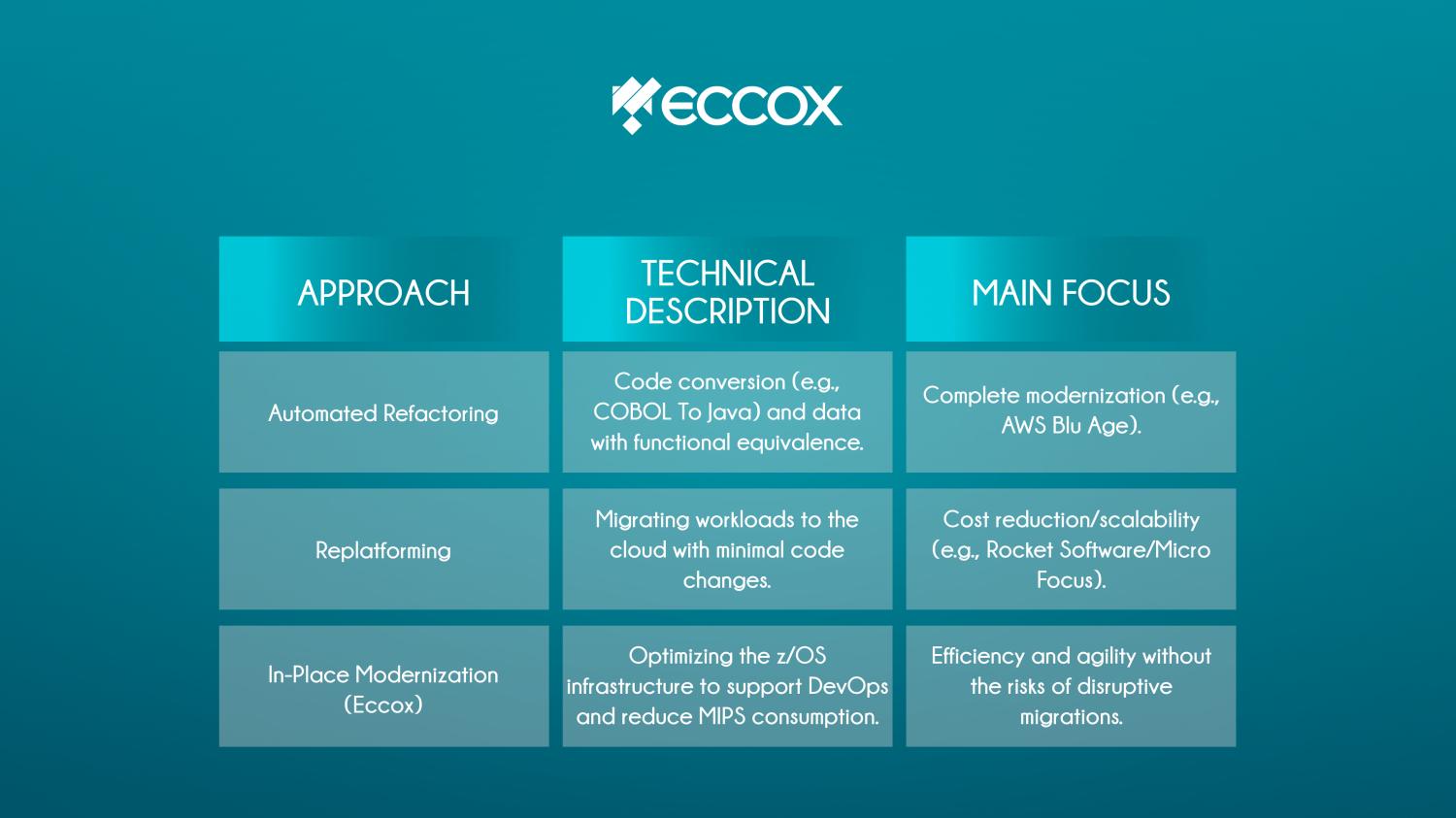
Modernizing does not necessarily mean "leaving the mainframe", but rather integrating it into the current paradigm. The goal is to allow distributed applications (Java, Python) to consume z/OS resources with the same latency and fluidity as cloud-native microservices.
The Parallel Testing Revolution with Eccox APT
Historically, testing consumes up to 50% of development time and budget in the mainframe.
The traditional model depends on manual DBA tickets, with SLAs ranging from 12 to 15 days just for environment provisioning. This latency is the opposite of DevOps.
Eccox APT (Application for Parallel Testing) breaks this paradigm by introducing the “final frontier” of DevSecOps in z/OS: isolated test tracks for CICS, IMS (DC and DB), MQ, and Db2.
Real parallelism vs. emulation: unlike emulation tools that fail to replicate mainframe transactional complexity, APT uses real components and cloned data. This enables multiple squads to test changes on the same tables simultaneously in isolated tracks, eliminating conflicts.
Self-service model: APT removes the human bottleneck. Developers from distributed platforms can provision test environments in seconds, without relying on manual infrastructure intervention or DBA ticket queues.
Data isolation: ensures that changes in one test track do not contaminate other projects or production data, preserving full application lifecycle integrity.
Tangible results: ROI and the cost of inaction
The technical efficiency of Eccox APT directly translates into operational ROI. Institutions implementing this technology typically achieve payback within 6 to 8 months.
Bradesco Case (BIN Project)
In the critical challenge of migrating to the 8-digit card standard, the project involved massive volume: 3 LPARs, 218 online programs (IMS and CICS), and 1,253 batch programs.With Eccox APT, the bank achieved an 88% reduction in delivery time and environment provisioning, proving the solution scales for massive transaction volumes.
Itaú Case
The institution recorded a 25% reduction in overall project Time to Market.
Using APT allowed developers with no previous mainframe specialization to operate autonomously within squads, creating test environments without depending on infrastructure specialists.
The risk of ignoring these practices is measured in millions. The Brazilian financial sector has already recorded losses of R$490 million in a single day due to releases deployed without proper quality gates.
Eccox APT acts as a safeguard against this “Cost of Inaction.”
The future of modernization: generative AI and the z17 mainframe
We are entering the era of real-time inference. The launch of the IBM z17, with Telum II processors and integrated AI accelerators, signals that the mainframe will become the center of predictive intelligence.
Generative AI accelerates this evolution in two ways:
Assisted transformation: tools like IBM watsonx Code Assistant accelerate COBOL-to-Java refactoring
Predictive impact analysis: Eccox is integrating AI into APT to identify, in seconds, which programs will be affected by changes in a Db2 table—something that previously took days. This enables sprint planning with unprecedented precision.
The journey from idea to operation in z/OS requires overcoming both cultural and technical barriers. Far from being obsolete, the mainframe remains the most robust platform for high-volume digital economies.
The winning strategy treats the mainframe as an agile asset within a hybrid infrastructure.
Eccox-led modernization ensures that digital agility and transactional stability coexists—turning legacy systems into a competitive advantage.
If implementing agility in the mainframe without compromising stability still feels like a dilemma in your organization, the issue may not be the technology—but the model.


About Post Author