Mainframe infrastructure remains the center of gravity for critical transactions in the Banking, Financial Services, and Insurance (BFSI) sector.
For organizations operating at the scale of hundreds of thousands of MIPS, z/OS is not a static legacy—it is a high-performance platform that sustains the global economy. However, the cost of maintaining the status quo has become prohibitive.
The “Mobile Effect” illustrates this urgency: financial institutions are facing infrastructure cost increases of up to 35% without any gain in new business transactions, driven solely by repetitive queries via mobile devices.
Mitigating this resource waste and orchestrating an evolution toward hybrid architectures is the only path to sustaining ROI and operational agility.
Market dynamics and cloud risk governance
The global mainframe modernization market is projected to reach USD 12.77 billion by 2032, with a CAGR of 9.39%. This growth reflects the need for scalability and cost efficiency (OPEX). However, cloud strategy requires vigilance.
A critical governance risk today is the changing availability of managed services, such as AWS Mainframe Modernization (Managed Runtime), which will stop accepting new customers on November 7, 2025.
In this context, Eccox Technology positions itself as a technical authority advocating for data sovereignty.
The mainframe is evolving (as seen with the IBM z17, featuring integrated AI accelerators, and z/OS 3.2), and modernization must prioritize self-managed or hybrid approaches to avoid lock-in and ensure business continuity in an integrated digital ecosystem.
The 7 Rs framework: a strategic decision matrix
Selecting the right migration strategy is critical to avoiding systemic failures. High-complexity projects require a deep understanding of dependencies, especially when transitioning from COBOL to modern languages.
Modernization Strategy Matrix
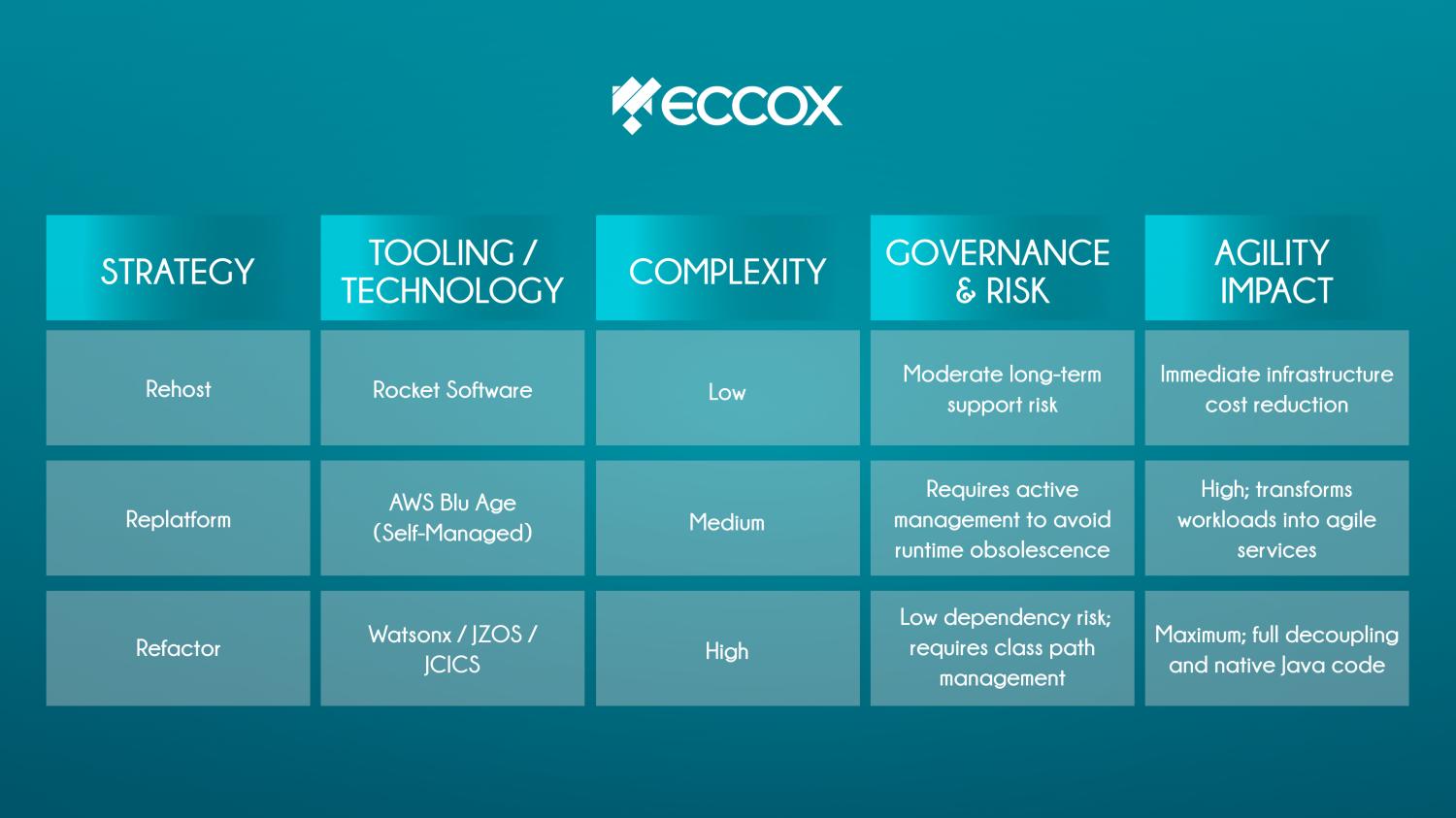
The evolutionary journey proposed by AWS (Assess, Mobilize, Migrate, Optimize) gains maturity when Refactor is included. This path requires the use of JZOS (Java Batch Launcher) and JCICS to faithfully emulate COBOL behavior in Java.
Replatforming still dominates the market due to its cost-benefit ratio, but the success of any “R” depends on rigorous dependency management between the transactional core and peripheral systems.
Decoupling patterns and data isolation
Technical decoupling is the mechanism that eliminates technical debt and allows development squads to operate independently of the mainframe lifecycle.
- Abstraction via gateways and DDF: secure integration requires the use of DDF (Distributed Data Facility) so that Java/Python applications can access Db2 transparently. CICS and IMS gateways, combined with IBM MQSeries, act as abstraction layers, enabling the mainframe to function as a robust service provider for the API ecosystem.
- Baseline data matrices: data isolation goes beyond simple cloning. Implementing “Data Mover” and “Snapshot” techniques enables the creation of environments with data anonymization, ensuring compliance with LGPD and GDPR (DevSecOps). By isolating critical Db2 tables, conflicts between parallel squads are avoided, preserving production data integrity.
Eccox APT: real parallelism with test tracks on z/OS
Eccox APT (Application for Parallel Testing) resolves the historical bottleneck of resource contention in shared environments. It operates as a Self-Service Platform, enabling the creation of isolated test tracks that use real middleware (CICS, IMS, MQ, Db2), with cloned components and data.
- Virtual tracks: the technology allows multiple developers to execute unit and integration tests simultaneously in isolated lanes. This results in a 70% to 80% reduction in total test cycle time.
- Transaction Discovery and XREF: the Discovery feature replaces manual processes that used to take up to 15 days. In seconds, APT identifies impacts across interdependent tables and programs, mapping the full call chain and mitigating production risks instantly.
The effectiveness of this approach was validated in Banco Bradesco’s “Future of BIN” project.
Driven by a regulatory change from Visa/Mastercard (transition from 6-digit to 8-digit BIN), the institution needed to modify 218 online programs and 1,253 batch programs under a strict timeline to avoid penalties.
Project highlights:
- Environment provisioning: 87% reduction
- Time-to-market (T2M): 88% reduction
- Manual effort (headcount): 88% reduction
- Orchestration: a single squad of 6 developers operated via virtual tracks without interfering with the bank’s global operations, ensuring regulatory compliance within the deadline.
These results prove that modernization supported by tools like Eccox APT, ESX, and DSX eliminates MIPS waste and aggressively optimizes OPEX.
Beyond cloud: strategic return to on-premise
Mainframe modernization does not point exclusively to the cloud. There is a strategic return to on-premise environments for high-density workloads, driven by data sovereignty and energy costs.
Microsoft’s decision to reactivate power plants to sustain data centers in Arizona signals that the energy density required by AI makes processing close to the data (mainframe) a competitive advantage.
The future integrates AI into automated refactoring and infrastructure optimization. Eccox Technology provides the technical “DNA” that enables engineering leaders and C-level executives to eliminate technical debt and turn the mainframe into an ROI engine for 2025.
Evaluating your capability for parallel testing and data decoupling today is a prerequisite for survival tomorrow.
If mainframe modernization is already on your strategic agenda, the next step is not choosing an “R”—it is understanding which one makes sense in your real context.


About Post Author