In today’s financial ecosystem, mainframe modernization has moved beyond the technical sphere to become an institutional survival imperative. Failing to modernize core storage is no longer just “technical debt” — it is a systemic risk to liquidity and regulatory compliance.
To sustain competitiveness, the Performance pillar must be treated as a strategic asset: without an agile transactional foundation, innovation dies at the front end.
Financial institutions are currently experiencing a growing operational asymmetry: processing consumption continues to increase, while monetization per digital interaction steadily declines.
The result is silent pressure on infrastructure costs, especially in mission-critical environments such as IBM Z. In this context, modernizing storage is no longer about technological expansion — it becomes a strategy for operational efficiency and sustainability of the transactional core.
To support this volume without letting infrastructure costs erode margins, the storage system must be renewed. The challenge, therefore, is to carry out the technological refresh without interrupting the vital flow of data.
The storage refresh challenge: why “stopping the bank” is not an option
Storage is the circulatory system of IBM Z and the repository of the Ledger — the institution’s single source of truth.
Replacing storage hardware is one of the most critical moments, as any data corruption during migration represents a “terminal event” for the bank. This complexity is amplified by the need to maintain 24/7 operations, where maintenance windows simply no longer exist.
Unlike traditional approaches, often disruptive and dependent on fragile emulation, pragmatic modernization requires mitigating specific technical risks that threaten business continuity:
Data corruption during migration traffic: integrity failures when moving the Ledger between different-generation subsystems.
Batch window compression: double-digit annual processing growth (driven by Pix and real-time payments) reduces the time available for validation and migration.
MIPS inflation from inefficient APIs: difficulty validating how new hardware latencies respond to thousands of API calls that depend on instant responses to maintain user experience.
Mitigating these risks requires a layer of intelligence that enables real, isolated testing — ensuring full predictability before the final cutover.
Eccox APT: logical isolation for secure migrations on z/OS
Eccox APT (Application for Parallel Testing) redefines test environment management on IBM Z, acting as a key component for validating infrastructure modernization under real load conditions.
Unlike emulation tools that rely on stubs or mocks, Eccox APT uses isolated test tracks to separate applications and data (CICS, DB2, IMS, MQ).
The solution clones components and data, allowing developers to use real z/OS middleware within isolated lanes.
This enables the use of features such as zIIP offloading and the validation of complex flows without risking production contamination.
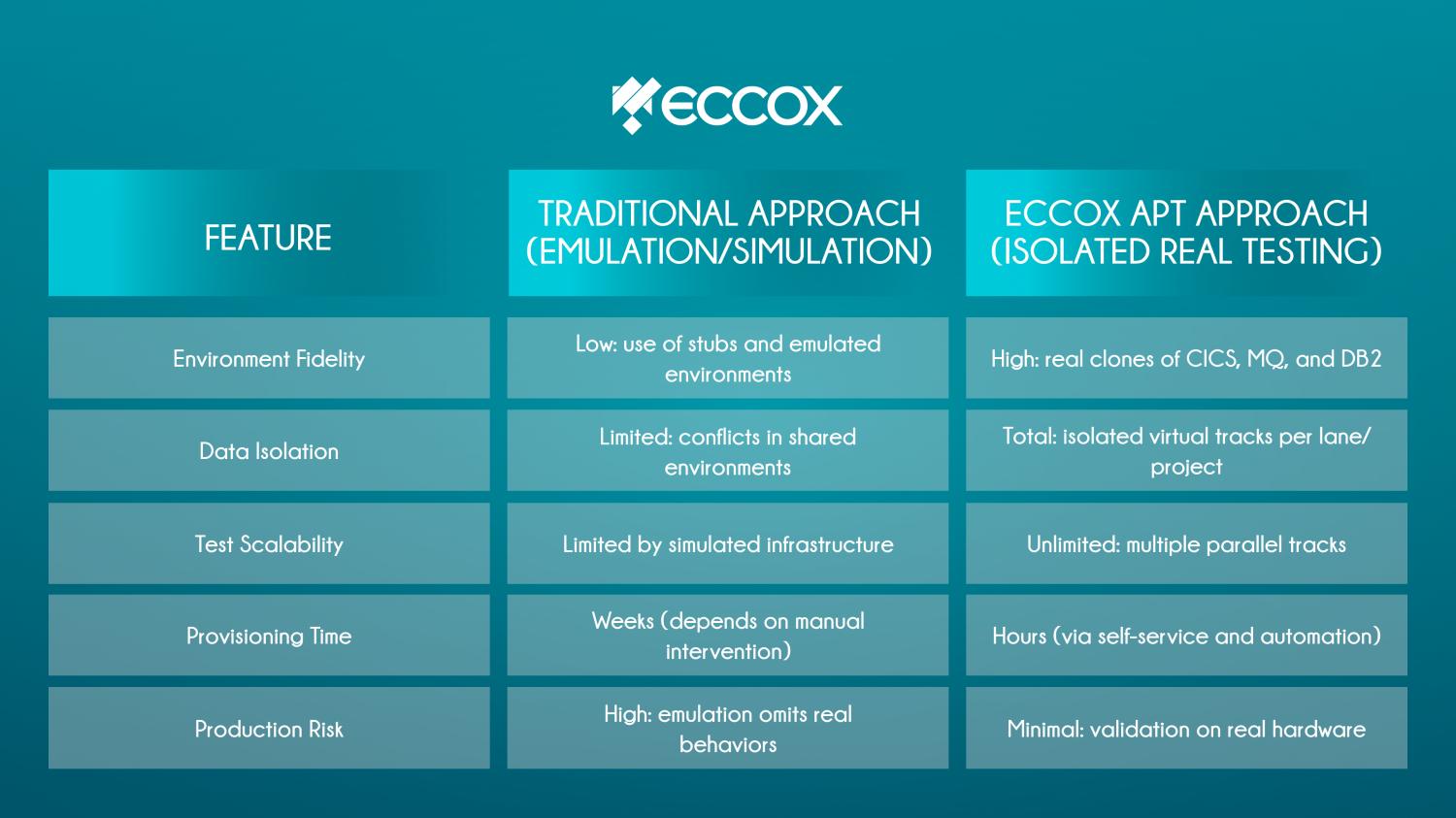
This technology is a strategic differentiator, ensuring that storage refresh supports the latency required for instant payments and real-time API orchestration.
Case study: real impact on banking efficiency
The effectiveness of this approach is demonstrated by large-scale operations handling massive MIPS volumes.
At Banco Bradesco, operating at a scale of 750k MIPS, Eccox APT played a key role in the migration to the new card standard (8-digit BIN). Audited results show unprecedented operational rigor:
Significant FTE reduction: provisioning workforce dropped from 18.35 to 0.86 full-time equivalents.
Provisioning agility: 87% reduction in mainframe environment preparation time.
Market acceleration: Time-to-Market reduced by 88%, turning a technical bottleneck into a competitive advantage.
At Itaú (500k MIPS), the agility enabled by squads using Eccox APT reduced test scenario provisioning from 480 hours (4 weeks) to just 2 hours.
These indicators prove that storage refresh, when supported by technical governance, becomes an innovation accelerator — absorbing the impact of the “Mobile Effect” with cost efficiency.
Technical governance and decision criteria for pragmatic modernization
Eccox shifts the discussion from “hardware cost” to “integrity and predictability.” For architects and infrastructure leaders, successful modernization requires a rigorous checklist of best practices:
Automated impact analysis (Discovery/XREF): Eccox APT Discovery maps dependencies and performs cross-impact analysis in seconds, eliminating days of manual effort and uncertainty.
Data Mover & Snapshots for rapid recovery: the ability to create “snapshots” of data states enables instant restoration after batch failures, avoiding full restarts.
Sandboxes for incident validation: isolated environments (test tracks) reproduce production incidents with full fidelity, ensuring fixes and new hardware perform as expected before go-live.
Evolutionary modernization respects the historical robustness of IBM Z while integrating the agility required for Open Finance and hybrid cloud architectures.
The future of the mainframe is the Intelligent Core
The convergence between IBM Z’s robust hardware and Eccox’s software intelligence enables the financial sector to handle high-frequency demands without compromising stability.
The “Intelligent Core” is the only viable path to managing operational asymmetry and accelerating MIPS growth without a corresponding explosion in costs.
Eccox establishes itself as a reference in pragmatic modernization, focused on performance and business continuity. Storage refresh, once considered a high-risk project, becomes a smooth and secure transition under Eccox APT governance.
Infrastructure leaders and CTOs: the time to live with the risk of disruptive migrations is over. Today, it is possible to protect the Ledger, optimize MIPS, and modernize with predictability and control.
Explore how Eccox APT can serve as the foundation for your next storage upgrade — reducing uncertainty and accelerating your Time-to-Market. Talk to one of our specialists.


About Post Author