Mainframe modernization is facing an unprecedented operational asymmetry, driven by what the financial sector classifies as the “Mobile Effect.” The explosive growth of digital interactions (highlighted by Pix, which reached 63.4 billion transactions in 2024) has created massive pressure on core infrastructure.
This volume is largely composed of balance inquiries, status checks, and “chatty APIs,” which increase infrastructure costs by approximately 35% without generating proportional revenue growth.
The traditional shared test environment model has collapsed under this weight. Centralized environments turn provisioning into a process that takes weeks, creating availability conflicts that stall innovation.
Agility is no longer a competitive advantage—it has become a survival strategy, requiring a shift from sequential models to full parallelism.
Breaking dependencies: the anatomy of test tracks in z/OS
Eccox APT (Application for Parallel Testing) breaks the cycle of operational dependency by replacing shared environments with isolated virtual tracks. This technology allows each squad to operate within dedicated test tracks, eliminating bottlenecks and dependency on centralized resources.
The implementation of Self-Service Provisioning removes the burden from DBAs and support teams, enabling developers themselves to create accurate test scenarios.
The system’s technical effectiveness lies in the distinction between components:
Cloned Components: artifacts such as Db2 tables, VSAM files, and JCL are replicated to ensure absolute data isolation and execution logic integrity.
Real Middleware: unlike fragile emulators that fail under high-load scenarios, Eccox APT uses real middleware (CICS, IMS, MQ, and Db2). This ensures that tests validate call chains and data flows identical to production.
Reducing Time-to-Market: efficiency and ROI evidence
The transition to isolated environments translates into significant quantitative gains in financial performance. The agility provided by automated component discovery converts hours of waiting into active productivity and enables large banks to operate with fintech-like speed, backed by z/OS resilience.
Results observed in a reference implementation at Bradesco demonstrate the impact of this optimization:
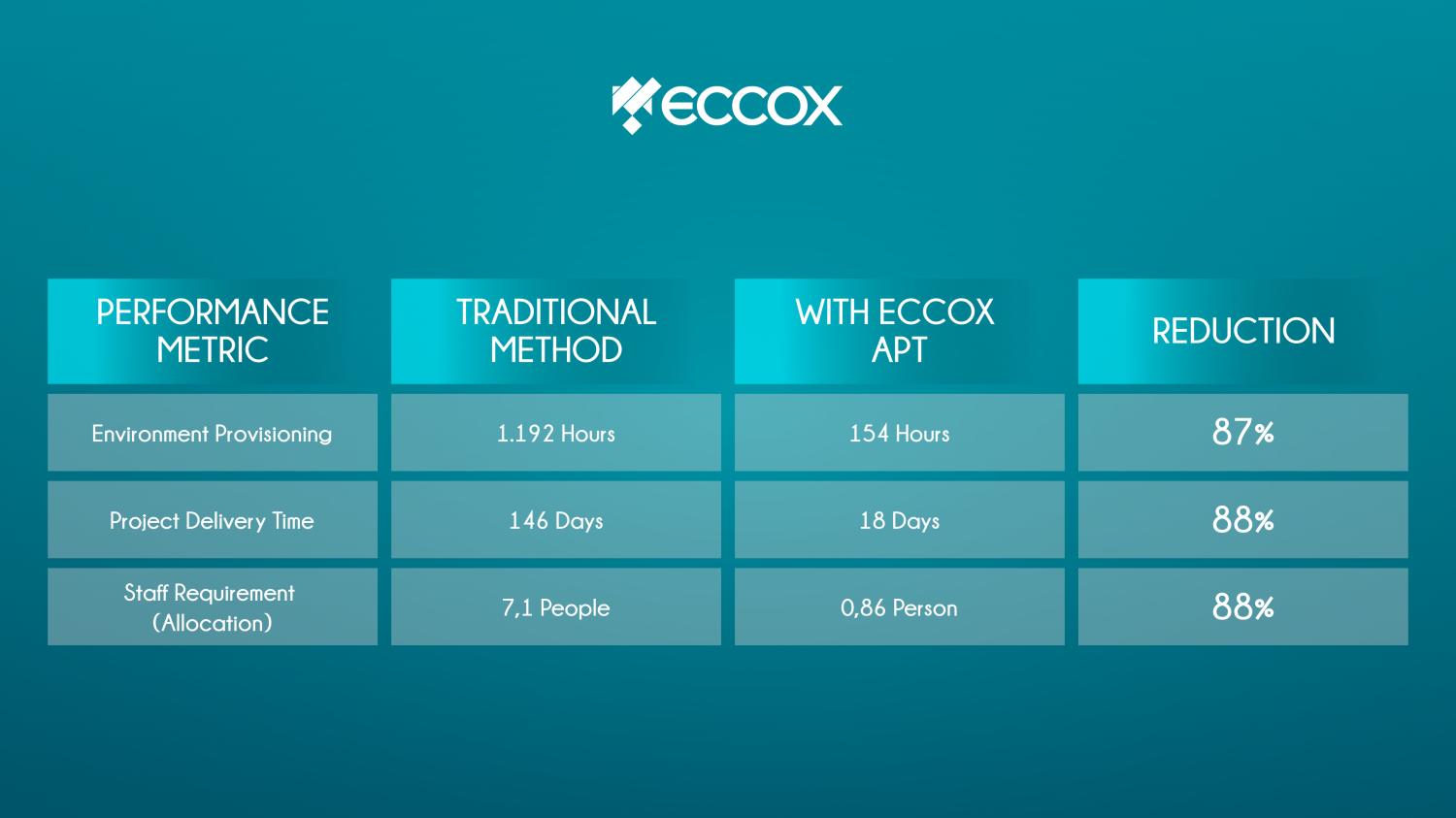
The 87% reduction in delivery time is the differentiator that protects institutions from technological obsolescence and market loss to more agile competitors.
Intelligence and traceability: Discovery and Snapshot
For QA Managers, security lies in visibility. Eccox APT provides analytical capabilities that serve as pillars of resilience and risk mitigation:
Discovery and xRef (Impact Analysis): the system identifies dependencies between programs and Db2 tables in seconds. Analyses that previously took days of manual mapping are now executed instantly, reducing risks in changes to critical tables.
Snapshot and Restore: in batch projects, Snapshot allows data states to be “frozen” and immediately restored after a failure. This eliminates rework and the need to restart long-running routines, ensuring test data integrity.
Traceability: the feature records every executed program, providing auditable evidence and full transparency of test coverage before promotion to production.
Successful mainframe modernization does not focus on replacing the platform, but on removing friction.
Even with ongoing cloud initiatives, institutions like Itaú have seen their MIPS processing grow from 420,000 in 2020 to 800,000 in 2024 to support real transactional demand.
The risk of neglecting test infrastructure is financially catastrophic. In 2014, one of Brazil’s largest payment companies learned—at a very high cost—what it means to underestimate the mainframe: two days offline, millions in losses. The cause? An attempt to decommission without a proper modernization strategy.
Eccox APT integrates Java and Python developers into this ecosystem through user-friendly interfaces, consolidating DevSecOps practices on z/OS.
Strategic verdict: investing in business agility
Investment in isolated environments delivers strong and accelerated financial returns (ROI). A 60% to 75% reduction in total testing time typically enables ROI within 6 to 8 months.
For technology leaders, effective modernization is not about replacing platforms—it’s about ensuring that innovation is not blocked by obsolete testing architectures. Removing operational friction is the only path to sustaining competitiveness in a real-time transaction market.
With 34 years of experience and market leadership, Eccox Technology is a pioneer in optimization, automation, and test acceleration solutions for the z/OS platform, supporting the technological evolution of the world’s largest financial institutions.


About Post Author